The Electric Guitar. How the Amplifier Became Part of the Instrument
 thermal
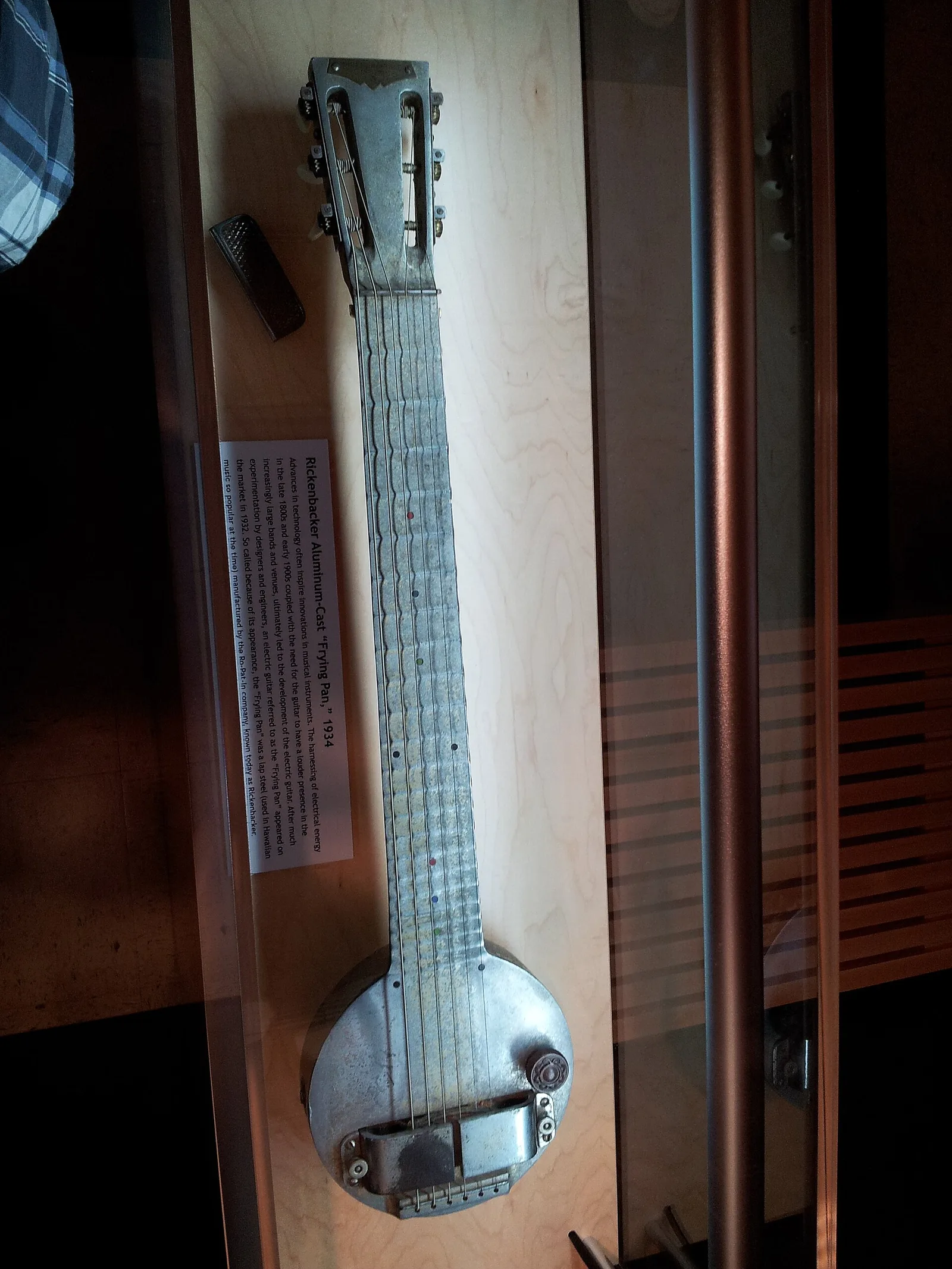
In an American big band of the thirties the guitarist sat somewhere between the double bass and the drums and dutifully hammered out chords on every beat, and the audience guessed at his existence mostly from the movement of his right hand. Such an orchestra had five trumpets and four saxophones, and a wooden box stood no chance against all that brass. In 1931–1932 in Los Angeles the musician George Beauchamp and the metalworker Adolph Rickenbacker placed a magnetic pickup under steel strings, a coil with a magnet over which the string vibrated and induced a weak current. The current ran down a wire to an amplifier, and the amplifier did not care how many trumpets were in the hall. The first one was cast in aluminium, a round body on a long neck, and the guitar was promptly nicknamed the frying pan. The patent for the frying pan came through only in August 1937, by which time Gibson had been selling its own electric ES-150 for a year.
An acoustic guitar gets its voice from its wooden body, while an electric one sounds from a speaker cabinet, so its sound is assembled on the way from the string to the speaker, in wires, tubes and a paper cone. Leo Fender repaired radios in Fullerton, California, never learned to play the guitar himself and looked at it like a radio repairman who has been brought a device. A device is what he built: a flat plank with a bolted-on neck that could be taken off with a screwdriver if it broke. In 1950 this plank with two pickups was renamed from Broadcaster to Telecaster, and it became the first solid-body electric guitar made on a production line. In August 1954 it was joined by the rounded Stratocaster, designed together with musicians and the engineer Freddie Tavares, with two cutaways on either side of the neck so the hand could reach the upper frets, and that silhouette is still what people draw when they need to depict an electric guitar in general.
 archive
A tube amplifier was conceived as a device that makes the guitar louder and changes nothing else in its sound. Guitarists quickly started turning the knob further than the manual intended, and then the tubes could no longer keep up and clipped the peaks of the wave. They clipped them gently, rounding them off, and added new harmonics to the note, many of them even, consonant with the fundamental, and at the same time squeezed the volume slightly, so the sound thickened and sustained longer. The ear takes this malfunction for warmth and meat. A transistor, when it hits its ceiling, cuts the wave at a right angle, its odd harmonics prickle, and guitarists have been arguing about tubes for seventy years now with the stubbornness of theologians.
The first overdrives got onto records through oversight. In 1951, as Ike Turner’s band was driving to Sam Phillips’s studio in Memphis, the car got a flat tyre on Highway 61, and guitarist Willie Kizart’s amplifier fell out of the trunk onto the asphalt. The cracked speaker cone was stuffed with crumpled newspaper, the guitar on “Rocket 88” droned dirty and rolling, and the record was later more than once called the first rock-and-roll record. Seven years later Link Wray deliberately poked holes in his amplifier’s speaker with a pencil, after a meaner sound for the instrumental “Rumble”, and got one mean enough that radio stations in New York and Boston refused to play a piece without a single word in it, fearing it would incite street gangs. Pete Townshend later wrote that without “Rumble” he would never have picked up a guitar.
In February 1961 it was the desk that broke. The country singer Marty Robbins released a placid song, “Don’t Worry”, in the middle of which session musician Grady Martin’s six-string bass suddenly croaked as if it had been dragged through a meat grinder, because a channel on the desk at the Nashville studio was acting up. Martin did not like the sound, but the producer kept the track. When the song reached number one on the country chart, engineers set about working out how to break the sound the same way, only on purpose, and in 1962 Gibson released the Maestro FZ-1 Fuzz-Tone, a little box that croaked on demand.
The shop-bought box did not suit everyone. In the summer of 1964 seventeen-year-old Dave Davies of the Kinks was so infuriated by the clean sound of his small Elpico amplifier that he took a razor blade, slashed the cone and ran the mutilated Elpico through a big Vox, and out of that croak grew the riff of “You Really Got Me”. A year later Keith Richards plugged a Maestro FZ-1 in at the studio and played the riff of “(I Can’t Get No) Satisfaction” through it.
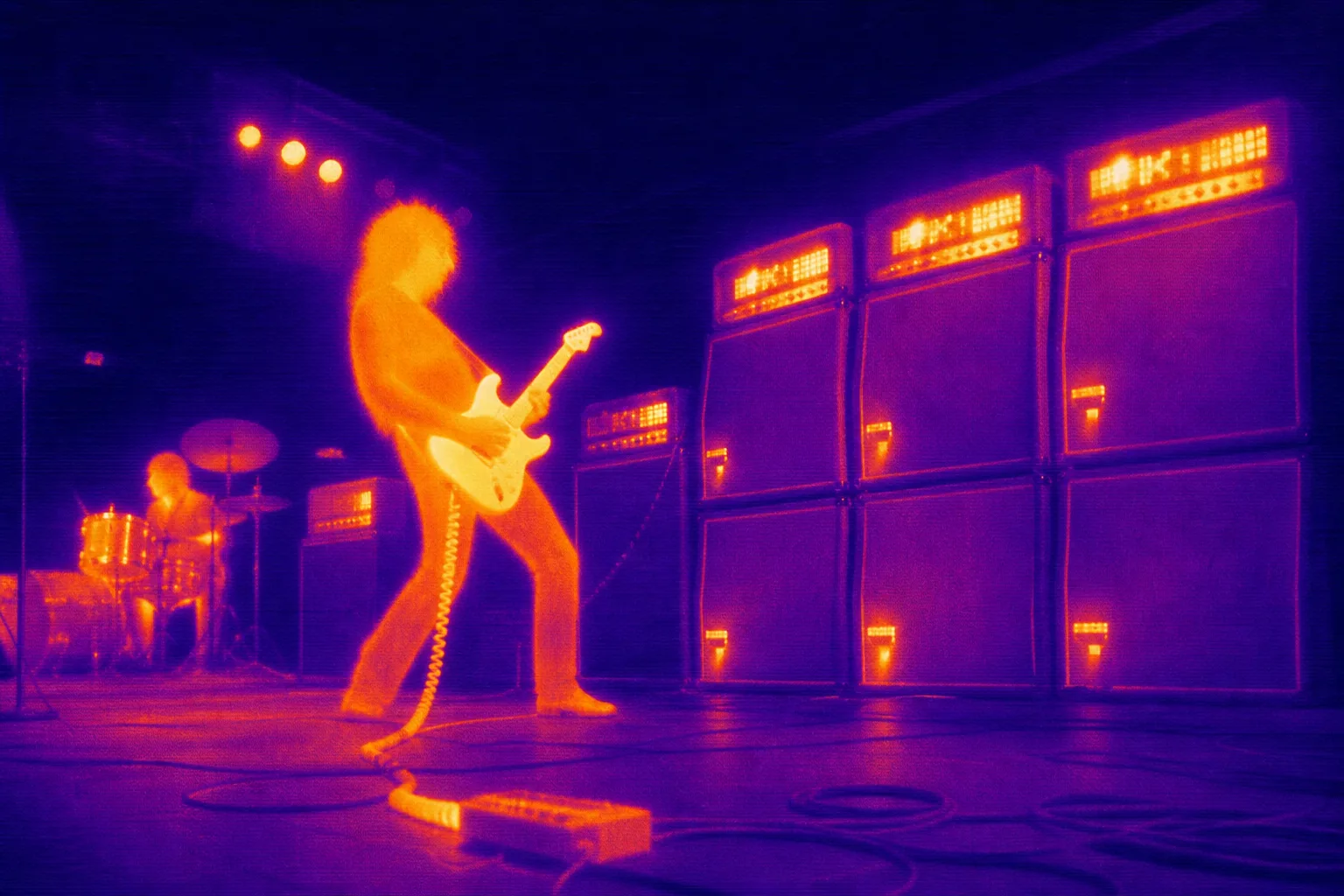
In Britain, meanwhile, it was a drummer who was making the guitar louder. Jim Marshall taught drums and owned a music shop in Hanwell, London, where in September 1962 his engineers Ken Bran and Dudley Craven built the JTM45 amplifier, modelled on the American Fender Bassman. Pete Townshend of the Who and Ritchie Blackmore came to try out the prototypes, and in the summer of 1965 Townshend demanded it louder still. Marshall doubled the number of output tubes, and out of such orders grew the wall that was nicknamed the stack, an amplifier on two cabinets as tall as a grown man. It was turned up until the tubes began to overload and howl, and a Marshall like that became the benchmark of rock guitar, to which, in my view, guitarists still pray.
Jimi Hendrix played on the same walls, and in January 1967 in London he met Roger Mayer, an acoustics engineer for the British Admiralty who soldered guitar effects in his time off from the navy. On the third of February Hendrix recorded the solo of “Purple Haze” through Mayer’s new box, the Octavia, and every one of his notes grew a shadow an octave higher.
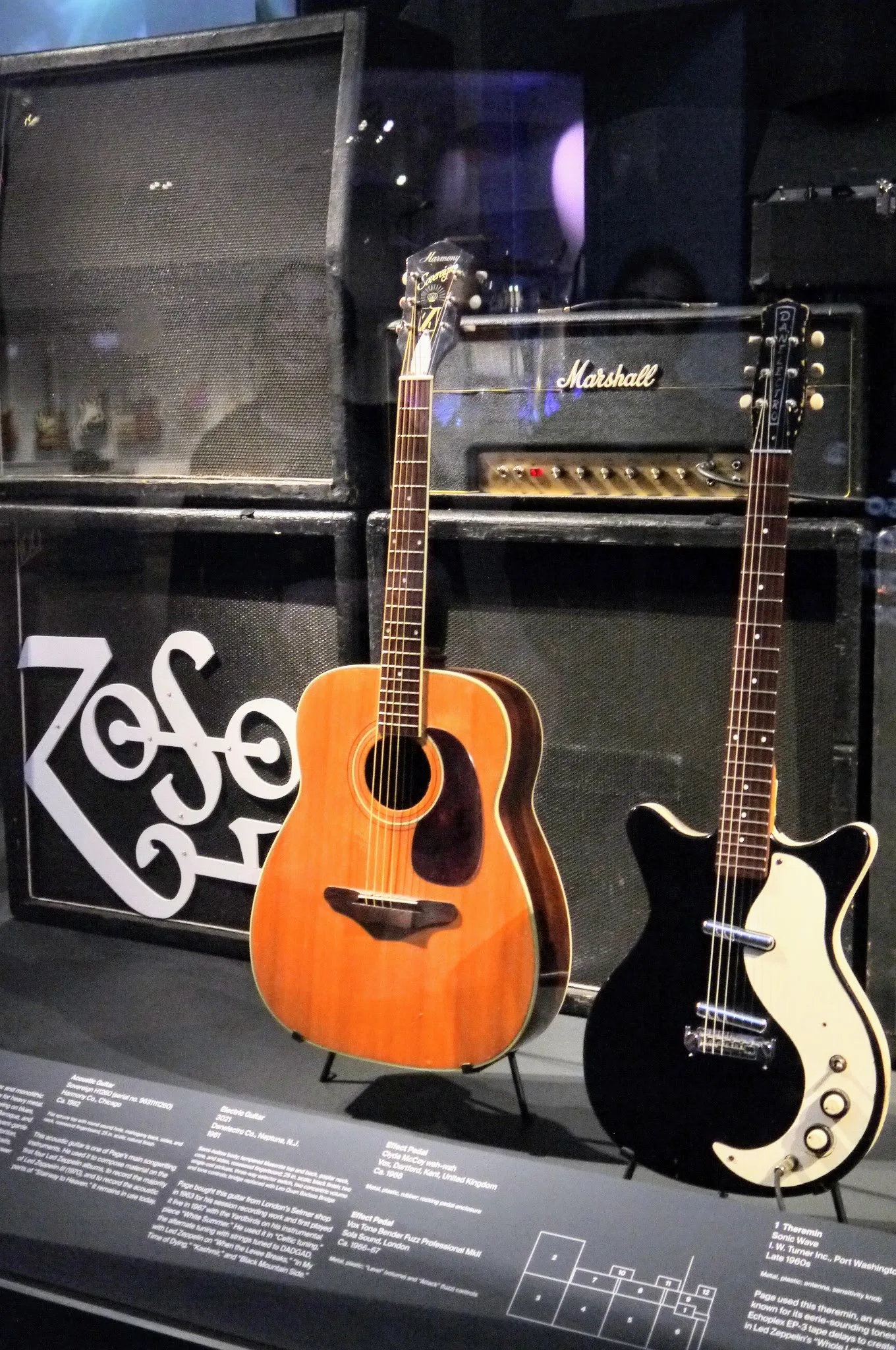
By the end of the sixties a rock guitarist had several iron boxes lying on the floor, and before reaching the cranked amplifier the sound wound through each of them. The wah pedal swept a filter under the foot, tremolo rocked the volume with a slow oscillator, and in the seventies they were joined by flanger and chorus, which mix into the sound a copy of itself with a tiny delay. In those same years Robert Moog was assembling the synthesizer out of the same kind of blocks, oscillators, filters and amplifiers, only his stood in one cabinet, while the guitarists’ lay on the floor, connected by cables that tangled underfoot.
 archive
I never became a guitarist, though I do own a guitar, and our relationship has turned out strange. I am almost left-handed, or, to be honest, more ambidextrous, that is, a person whose two hands never fully settled which of them is in charge. In golf, for example, I swing from both sides with equally modest results. I hit the ball, and where it flies after that is decided by practice, which I do not yet have. Of all instruments I feel closest to drums, which I now play in a rock band, then keys, and I bought the guitar as an adult and for a thoroughly mercenary purpose. A string gives a synthesizer a wonderful raw waveform, and a guitar effect, if you take off its iron case, is in its workings the same synthesizer module, only designed to be controlled by foot. They have long been released as plug-ins too, and people happily run synthesizers through them, so I bought the guitar as a textbook on effects chains, and the textbook honestly earned its keep. Now I can play chords, understand how frets work and remember a couple of scales, so at someone’s birthday I can strum something, and I find my way around signal routing like my own flat. The guitar itself, I am ashamed to admit, I chose by looks. It is an ALP, with the neck cut off along with the headstock, so there are simply no tuning pegs in the usual place, and folding fins stick out from the sides of the body, and it looks as if the crew of a passing ship forgot it on Earth. Its pickups are honest and very decent, but it is uncomfortable to play. The shape of a guitar decides in advance how your hands will sit, and with this guitar my two, equally uncertain, never reached an agreement.
In the nineties the amplifier was fitted into a desktop box. Michel Doidic and Marcus Ryle, who had previously designed guitar effects, founded Line 6 in 1996, and in 1998 released the POD, a red bean-shaped box inside which a processor impersonated fifteen famous amplifiers together with their cabinets. Before, to record a guitar at home you needed a tube combo, a microphone and very patient neighbours. Now the guitar was plugged into the bean, the bean into the computer, and the neighbours slept soundly. The sound inside the POD was dialled in by programmers who spent hours listening to real amplifiers and tweaking formulas until the copy came close to the original by ear.
Christoph Kemper, one of the creators of the Access Virus synthesizer, took up the guitar in 2006 and five years later released the Profiler, which no longer needed a programmer with formulas. The device was connected to a real combo, ran test signals through the amplifier on its own, listened through a microphone to what came out of the cabinet, and took a profile of that particular unit, a digital cast that could be taken on tour instead of the combo itself.
In 2019 the American engineer Steven Atkinson began writing Neural Amp Modeler, and at the start of 2022 he released it for free, with open source code. Nobody fits formulas to a particular amplifier in it. The neural network listens to what goes into an amplifier and what comes out of it, and learns to repeat that transformation with all the irregularities, with the way a tube stage squeezes the sound and how differently it responds to a hard and a soft pick attack. Musicians upload captures of their amplifiers and pedals for one another, and by March 2026 there were more than six and a half thousand of them on the Tone3000 site. In the summer of that year the second version of the program came out.
All these machines worked with sound born by a string. To build sound with no string at all, from scratch, it first had to be taken apart.