The Most Important Wave in the History of Music
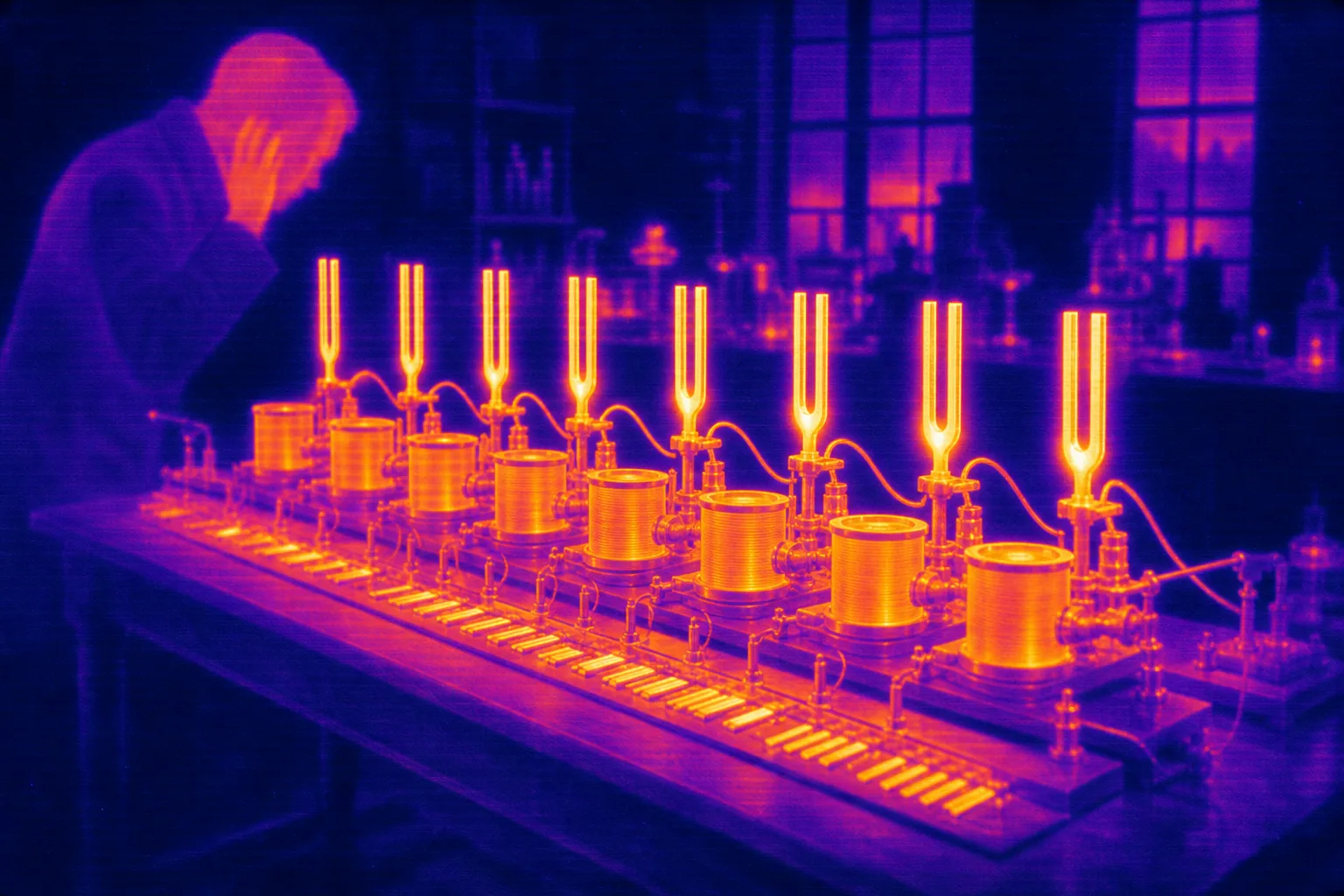 thermal
Take a violin and a flute and play the same note on both, the A above middle C that the orchestra tunes to. The pitch of the two notes will match to the hertz, the volume can be adjusted, and still any person, even someone who cannot tell Mozart from Salieri, will say with eyes closed, in a fraction of a second, which is the violin and which is the flute. Musicians call this difference timbre, the colour of a sound, and for centuries they used the word without really understanding what stood behind it. The answer was found in a problem about a heated metal plate.
The problem was solved by Joseph Fourier, a French mathematician who had managed to go to Egypt with Napoleon and serve as prefect in Grenoble. At the start of the nineteenth century he was preoccupied with how heat spreads through a metal plate. To answer that question he devised a way of breaking a complex curve down into a sum of simple waves, the smooth sine waves of the school textbook, and declared that any periodic oscillation at all could be broken down this way. He presented his first memoir in 1807, his colleagues at the Academy received it without enthusiasm, and the full theory came out in 1822 as a book with a completely unmusical title, “The Analytical Theory of Heat”. The decomposition without which no synthesizer works today was invented by a man thinking about hot iron.
This chapter is in the full book
The prologue and the first three chapters are open. The rest of the book, 44 more parts with illustrations, in four languages, opens after one payment. Yours for good.
Sign in first: the book is tied to your INITE account, so it opens on any device.