Sound You Can Cut with Scissors
 thermal
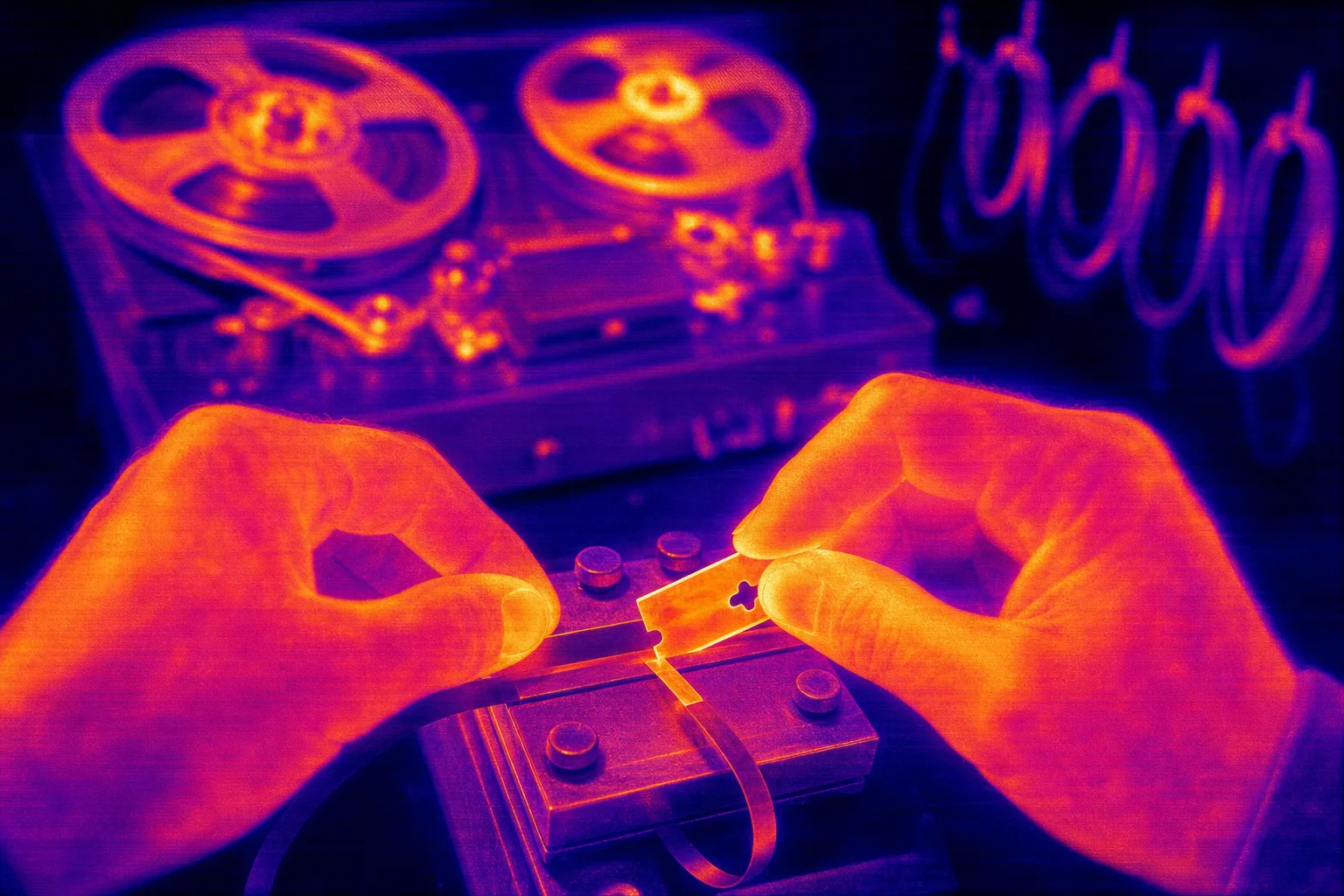
I was about five, it was in Stavropol, in the Mamayka district, where my mother’s brother lived, and this brother had a reel-to-reel tape recorder, huge, with two reels the size of soup plates, and next to it equally huge Radiotehnika speakers. The reel bore four letters, BASF, and I remembered them for the rest of my life, though I learned what they meant much later. I had known cassettes for a long time by then. I was first allowed to touch a cassette recorder at three, and when scarce large batteries turned up in Soviet shops, I was even taken out for walks with it. My mother later recalled that I was the only one who could get a cassette out of that recorder, because the standard mechanism in Soviet portable recorders worked loose very quickly and obeyed only someone who knew how to handle it. Reels were a different magic altogether. In a reel-to-reel everything spun and turned at once, and while the needles of the meters jumped to the music, the rollers bounced at every jerk of the tape. What I loved most was the minute when my uncle threaded the tape. The brown tape went from one reel to the other through the slot with the heads, and I was allowed to hold the reel with my finger, and I held it with the seriousness of a bomb-disposal expert, because the machine was always trying to chew the tape. The tape would sag in a lazy loop, then pull so tight that I stopped breathing, and I liked that danger hardly less than the music. And what was turning on those reels was Depeche Mode’s “Violator”, and “Personal Jesus” soaked into me along with the smell of a warm tape recorder. It was almost certainly a copy of a copy, like most Western music in the Soviet Union, and the band earned exactly nothing pounds nothing pence from it. That these people built songs out of synthesizers and sounds recorded on a construction site, and that the very idea of moulding music out of recordings had come to a French radio engineer more than forty years earlier, I of course had no idea. It was enough for me that the music travelled along the brown tape right under my finger and could be slowed down if I wanted.
The tape I was holding with my finger was by then more than half a century old. Before it appeared, electricity had already learned to give birth to sound, but every note still had to be played by hand in the very second it was heard. Edison’s phonograph had been able to store sound since 1877, but a cylinder or a disc could only be played back; you could not take scissors to them and recut them. Tape turned sound into a thing that could be cut, spliced, reversed and stretched, which gave the machine the second most important job after producing sound: remembering it.
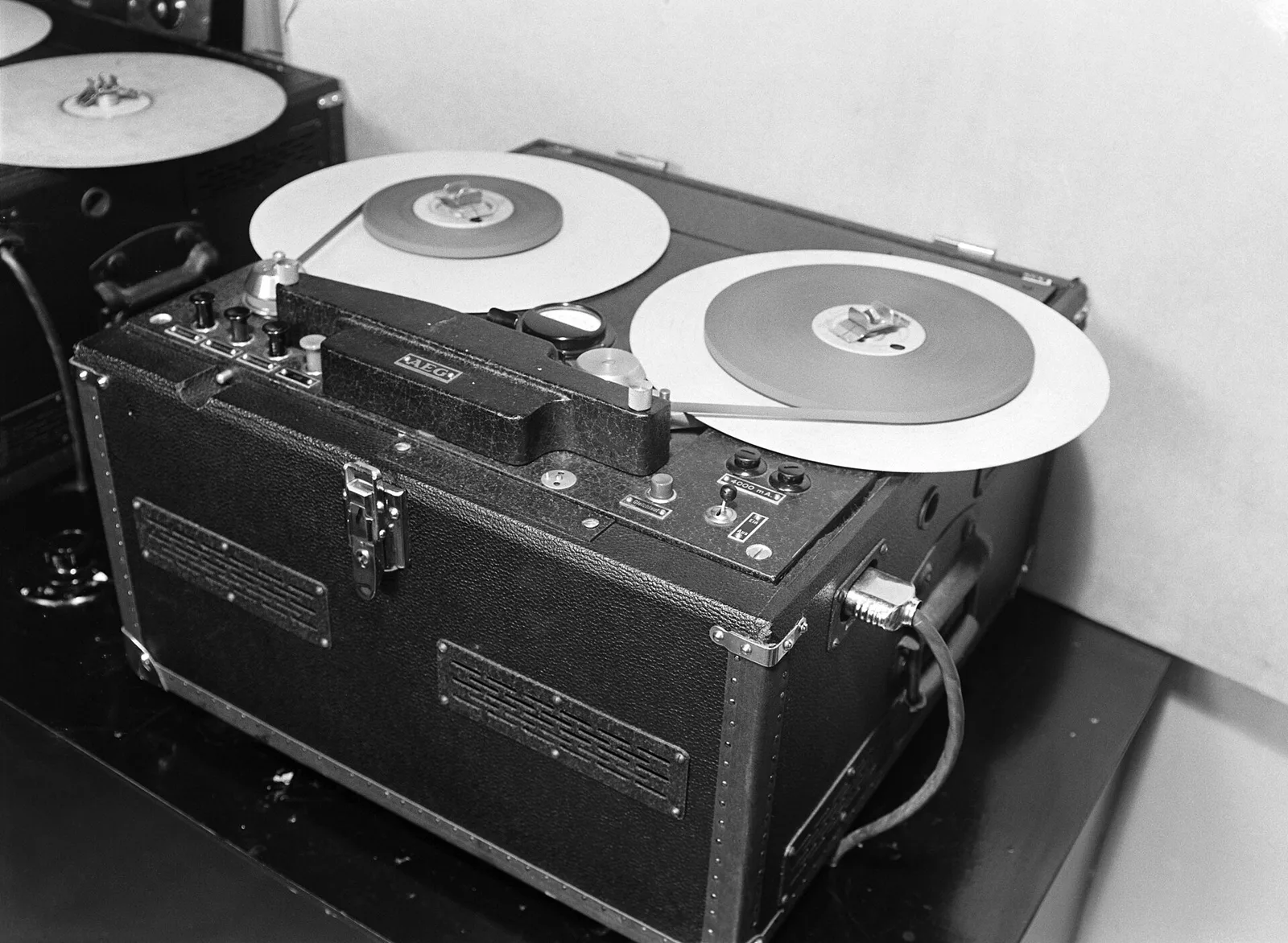
The tape recorder was invented in Germany. AEG engineers showed the first model, the Magnetophon K1, at the 1935 Berlin radio exhibition, and the tape for it was made by the chemical concern BASF. The first machines sounded so-so, with hiss and distortion, until in 1941 the engineers Hans Joachim von Braunmühl and Walter Weber hit on mixing into the recording an inaudible high-frequency signal many times louder than the music itself. It sounds like a mockery of common sense, but the trick removed the distortion, and the recording quality suddenly became such that specialists could not tell tape from a live performance. German radio used this throughout the war: programmes recorded in advance went on the air as though the orchestra were sitting in the studio right now. An American signalman, Jack Mullin, serving in England, listened at night to German radio, where the Berlin Philharmonic sounded live, without the usual crackle of records, at any hour of the day or night, and reasoned that even Hitler could not make musicians play round the clock without days off, which meant the Germans had some recording device no one knew about.
In 1945 Mullin found such machines in the studio of Frankfurt radio in the spa town of Bad Nauheim, shipped two of them home, improved them and began showing them to engineers. The demonstrations were seen by a small Californian firm, Ampex, which took on making its own tape recorder, and by Bing Crosby, one of America’s most popular singers, who wanted to record his radio show in advance just so he would not have to sing live on air every evening. Crosby invested in Ampex, and by the end of the 1940s magnetic tape was the standard in American radio studios. So an invention that German radio had used to pass off recordings as live broadcasts sailed to America and went back to its old trade there.
 archive
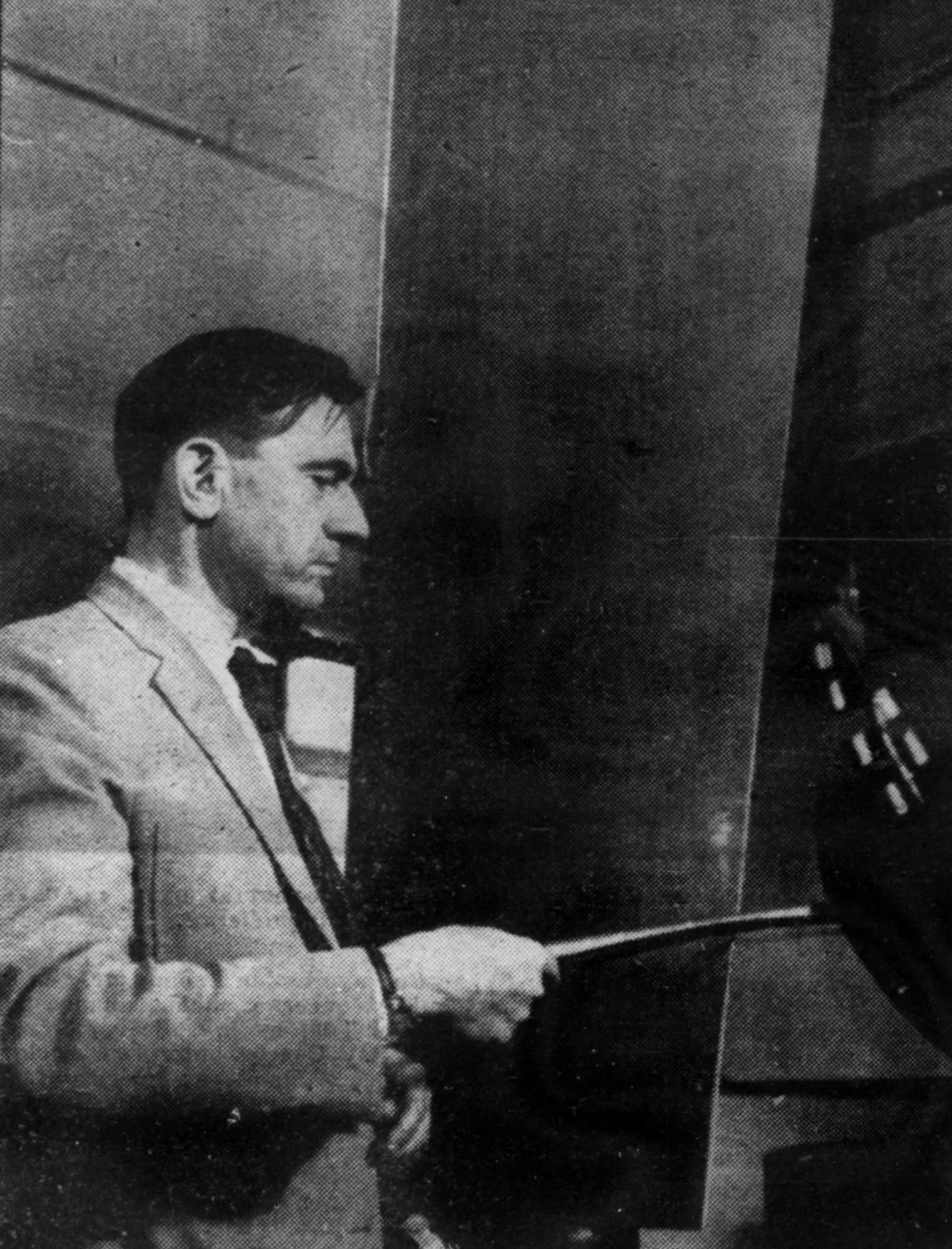
In France, meanwhile, a radio engineer named Pierre Schaeffer was busy with things his bosses probably never fully understood. From 1942 he ran an experimental studio at French radio and collected sounds: trains, saucepans, children’s spinning tops. On the fifth of October 1948 his “Concert of Noises” went on the air, five short études, the best known of which, the “Railway Study”, was built entirely out of recorded locomotive sounds. The story is usually told as a story about tape, although Schaeffer made his first pieces on discs. He recorded sound onto a disc and then cut a closed groove into it, so the needle ran round in a circle and repeated the same fragment, and the result was a loop long before the word itself appeared. Tape recorders were brought into the studio in 1949, but they worked unreliably, and only by 1950 did tape push out the discs.
With tape, though, Schaeffer and the composer Pierre Henry, who had joined him, had real instruments. A sound could be slowed down by running the tape slower, and then it dropped lower and stretched out; it could be sped up, turned backwards, a fraction of a second cut out of it and spliced to another piece, looped, layered one on another. In 1951 the Groupe de Recherche de Musique Concrète was founded at the radio, and in 1953 the phonogène was built for it, a device that played a loop of tape at different speeds at the press of a key, so that one recorded sound became an entire scale.
Schaeffer did not choose the name “musique concrète” by chance. Ordinary music moves from abstraction to sound: the composer writes notes, the performers play them. Schaeffer went the other way and began with a concrete recorded sound, out of which he then moulded a composition, and any noise in the world, from the creak of a door to the whistle of a locomotive, became musical material in his hands. The result was sampling in its pure form, only done with scissors and glue thirty years before the first sampler, and the question of who owns a recorded sound that you have cut up and spliced your own way was born along with those scissors. While it was about locomotives, it bothered no one. It would bother everyone when instead of a locomotive the tape held someone else’s song, and in place of the scissors, in time, there was a neural network.
 archive
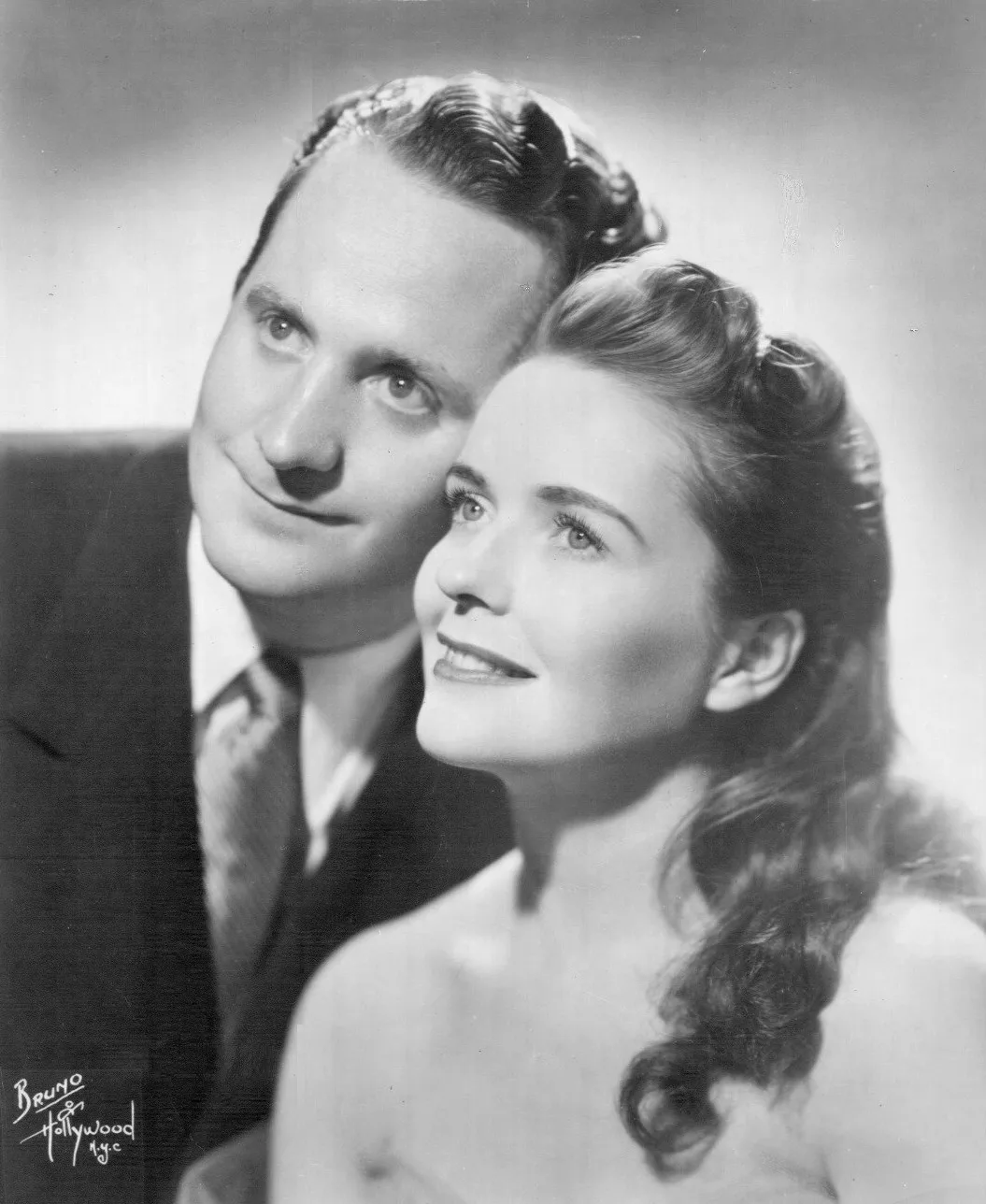
In America the same tape was adapted to a completely different task. As early as 1948 the guitarist Les Paul recorded “Lover”, in which eight guitar parts, all played by him at different speeds, were layered on top of each other on acetate discs, and each new layer meant a new re-recording of everything before it, with an inevitable loss of quality. In 1949 Crosby gave him one of the first Ampex tape recorders, and Les Paul did something with it the Ampex engineers had not anticipated: he added an extra playback head in front of the recording head, so the machine could simultaneously play back what had already been recorded and add a new part on top. The method was called sound on sound.
In 1951 “How High the Moon”, which Les Paul recorded with his wife, the singer Mary Ford, spent nine weeks at number one in the American charts. Mary’s voice in it sounds like a choir, although the whole choir consists of one Mary recorded many times over, and there are more guitars there too than one person has hands. Later Les Paul built an eight-track tape recorder with Ampex, which was nicknamed “the Octopus” for its number of tracks, and after that any part could be recorded separately, re-recorded until it came out right, and mixed afterwards. Now Les Paul could play for an entire orchestra by himself without leaving his garage.
The extra heads on the tape recorder also gave music echo. The recording head lays sound onto the tape, and the playback head, standing a few centimetres further along, reads it a fraction of a second late, and if you mix what it reads back into the live sound, every note comes back to the listener twice. If you feed the repeat back into the recording, it will return again, and again, quieter and murkier each time, until it dissolves in the hiss of the tape. Les Paul was one of the first to use this, and in 1954, at the Sun studio in Memphis, the producer Sam Phillips linked two Ampex machines and gave Elvis Presley’s voice on “Blue Moon of Kentucky” a short, whip-like echo that was later called slapback. Soon echo was packed into boxes. In 1958 the Englishman Charlie Watkins released the Copicat with a loop of tape inside, in 1959 the American Echoplex appeared, where the delay was changed by moving the heads, and in the seventies Ikutaro Kakehashi of Roland made the Space Echo with several playback heads, and on that box Jamaican dub masters would later build endless corridors of repeats.
Schaeffer and Les Paul worked on different continents and did opposite things with tape. The Frenchman turned everything that sounds in the world into music; the American turned one musician into a whole ensemble.
 archive
In 1963 tape sounded from the television. The composer Ron Grainer wrote the main theme for a new BBC series, “Doctor Who”, and handed it to the Radiophonic Workshop, where the engineer Delia Derbyshire worked. There were no synthesizers then. Derbyshire took a recording of a single plucked string, white noise and the simple waves of test oscillators, which were actually used to calibrate equipment and check studio acoustics, and assembled the melody out of them, note by note. She made each note separately, speeding up or slowing down the tape to get the right pitch, then cut a piece of the right length with a razor against a ruler and taped it to the next one.
When Grainer heard the result, he asked: “Did I really write this?” Derbyshire replied: “Most of it.” Grainer wanted to credit her as co-author, but the BBC would not allow it, because under corporation rules Workshop staff had to remain anonymous, and for many years one of the most recognizable electronic melodies in the world was credited to the man who had written the notes for it but never once held the razor.
Twenty years later, in 1983, Depeche Mode were recording the album “Construction Time Again” and doing the same thing as Schaeffer. The musicians walked around construction sites and hit pieces of metal with sledgehammers, recorded the knock of stones, the clatter of kitchenware, toy instruments, and then loaded all of it into Synclavier and Emulator samplers and built rhythms and melodies out of the recorded din. Work that took Schaeffer weeks of fiddling with a razor and glue was now done at the press of keys.
Six years later, when the band took on “Violator”, the sledgehammers gave way to people. In the summer of 1989 Depeche Mode recorded with the producer Flood, first in Milan, then in Denmark, and finished the album in London. The keyboardist Alan Wilder more and more often sat over the arrangements alone with Flood, having sent the others off for a walk, because the fewer people in the control room, the more you get done. For “Personal Jesus” Martin Gore brought a modest demo with only a beat and a melody on acoustic guitar. The stomping the whole song now stands on was recorded later, by getting people to jump on equipment flight cases, as if Schaeffer had gone out into the street with a microphone again. Gore wrote “Enjoy the Silence” as a slow ballad on harmonium, and Wilder and Flood turned it into a dance track, although the author himself resisted at first. When the album came out on the nineteenth of March 1990, fifteen thousand people turned up to an autograph signing in Los Angeles instead of the expected few thousand, so the police had to restore order. One of the countless copies of that album, dubbed from who knows what, was the one later turning on my uncle’s reel in Mamayka, while a five-year-old boy held the reel with his finger and waited for the machine to chew the tape.
By the middle of the century the machine could both give birth to sound and remember it, and remember it in such a way that the memory could be recut. But everything that sounded in it was still played, sung or recorded from a microphone by someone, and tape could not answer the question of what sound is made of in the first place and why a violin differs from a flute if both play the same note. Meanwhile electricity was already remaking the instrument on which Les Paul recorded his eight guitars.