Before the Synthesizer
 thermal
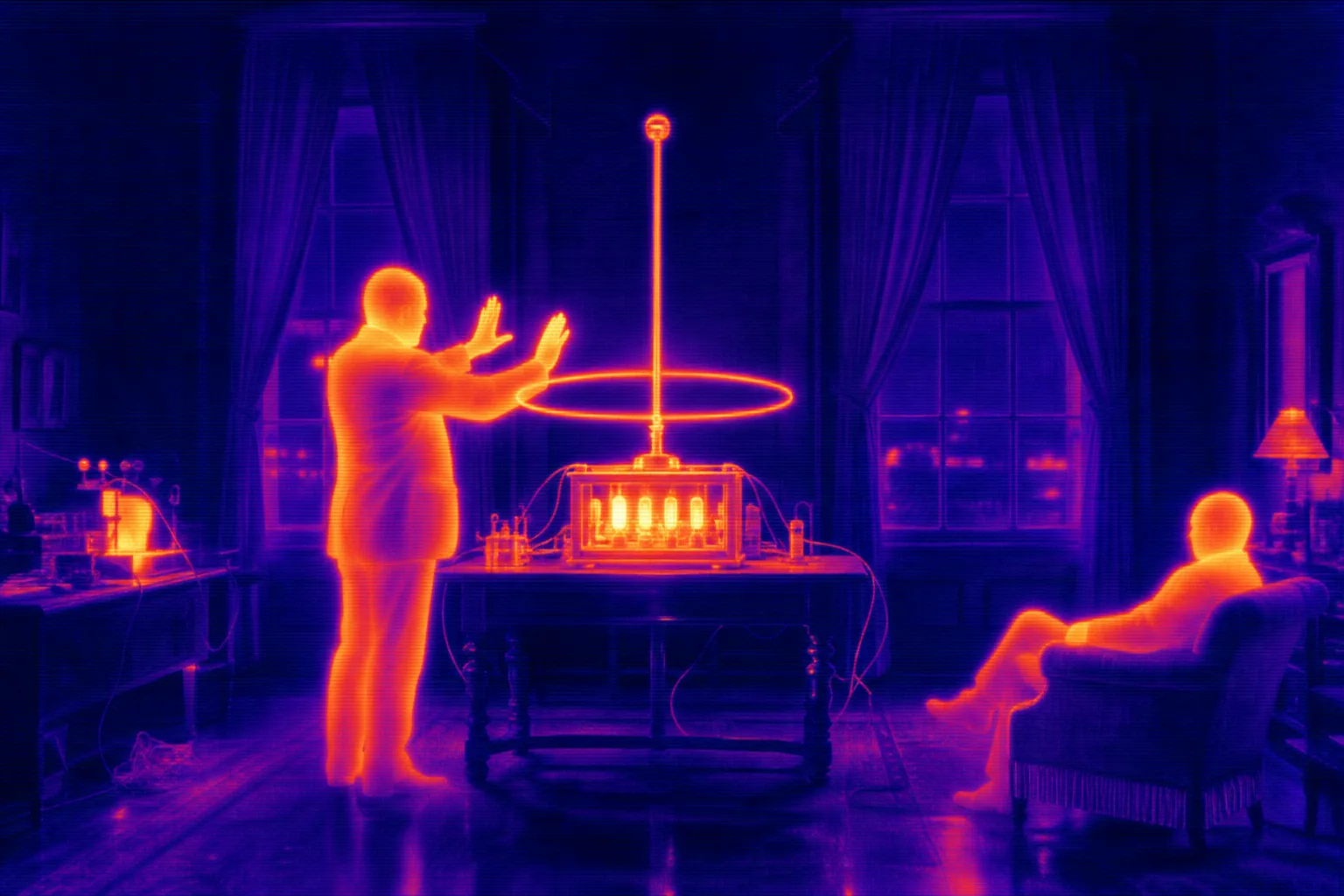
In March 1922 a twenty-five-year-old physicist named Leon Theremin brought a wooden box with two metal antennas to the Kremlin and showed it to Lenin. First he played it himself: a Scriabin étude, Saint-Saëns’s “The Swan”, Glinka’s “The Lark”. The box sang in a voice in which you could hear, all at once, a cello, a female soprano and a saw being played with a bow, while Theremin touched nothing and only moved his palms through the air, like a conductor whose orchestra has run away. Then he took the hands of the Chairman of the Council of People’s Commissars in his own, began to guide them near the antenna and somewhere in the middle of “The Lark” let go, so that Lenin finished the romance without outside help. The man who five years earlier had turned a huge country upside down became one of the first people on earth to play a melody on an instrument he had never once touched, though he himself hardly appreciated his achievement from that angle.
In 2008, in the Hohle Fels cave in southern Germany, archaeologists found a flute carved from a vulture bone, with neatly drilled holes, and dated it at a little over thirty-five thousand years old. From then until the start of the twentieth century the workings of music hardly changed: the body made the sound, and the instrument gave it shape. A flute turns an exhalation into a note, a violin turns the movement of a hand holding a bow, a piano turns the strike of a finger, which travels through a system of levers to the hammer and the string. Even the church organ, one of the most complex machines of the pre-machine age, with thousands of pipes and huge bellows that for centuries were pumped by specially hired men, merely distributed among the pipes air that someone’s hands or feet had pumped in. Every vibration that reached a listener’s ear began with a muscle.
Electricity broke that link. An instrument appeared inside which the vibration is born by itself, out of current, and all that is left for a person is to control it. From that moment the history of music technology becomes the history of which further part of their work people are willing to hand over to the machine, and the first thing they gave up was the oldest thing they had, the sound source itself.
 archive
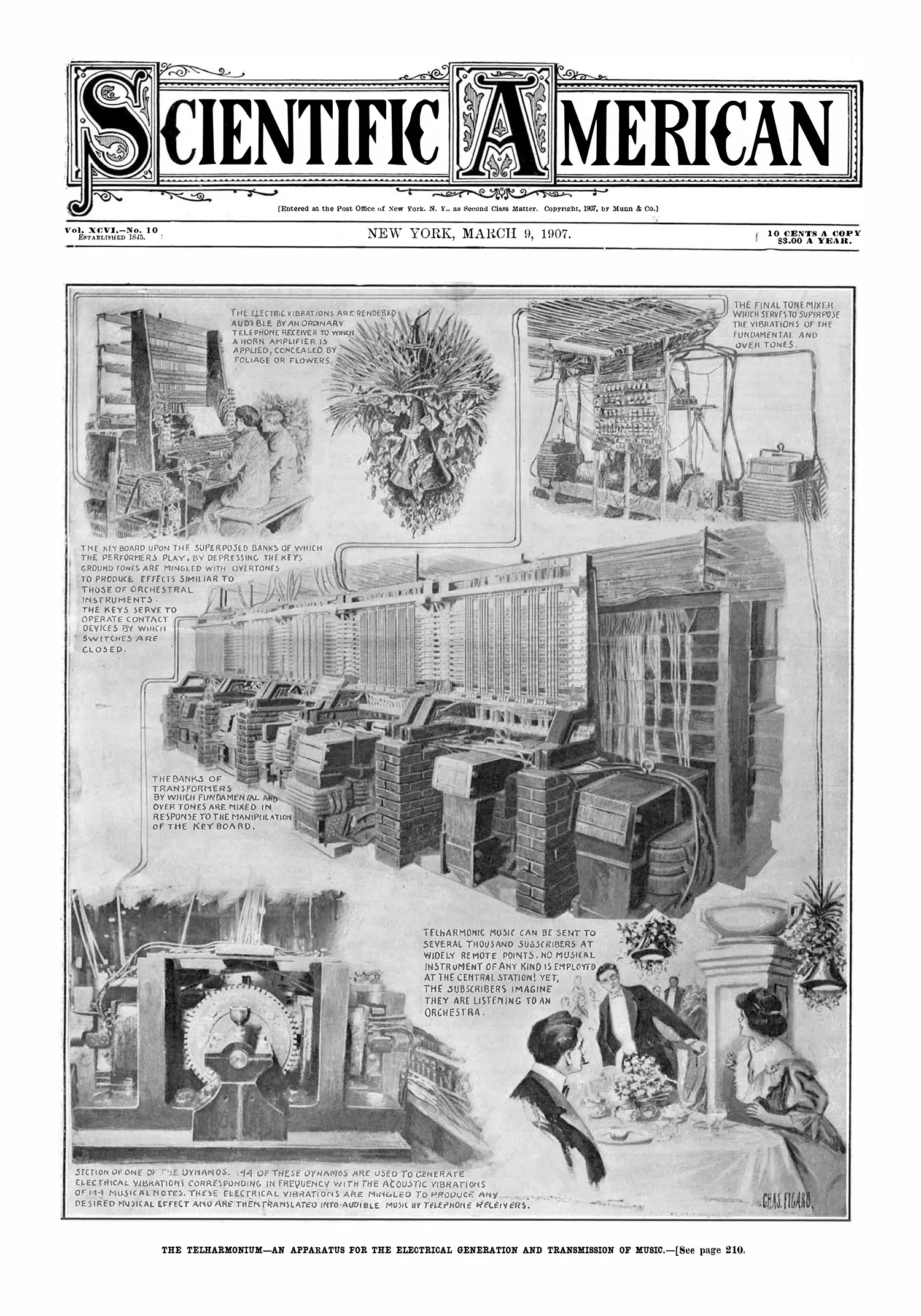
The first person to try to extract music from electricity on an industrial scale was Thaddeus Cahill, a lawyer from Washington who patented his machine in 1897. He reasoned like a true entrepreneur of the steam-turbine age: if a power station generates current and the telephone network delivers it to any home, why shouldn’t the power station generate music as well, to be sold by subscription, like gas and water? His Telharmonium consisted of alternating-current generators whose shafts spun so fast that the current in the windings oscillated at audio frequency. Each generator was responsible for its own note, and by mixing the currents of several generators you could change the timbre, so Cahill’s two-hundred-ton machine already ran on the principle synthesizers would be built on sixty years later: a complex sound is put together from simple ones.
The two hundred tons are meant literally. The second version of the Telharmonium, finished by 1906, weighed almost two hundred tons, stretched eighteen metres in length and had a hundred and forty-five generators, and moving it to New York took thirty railway flatcars. In a building on the corner of Broadway and 39th Street, Telharmonic Hall opened, from which music was sent down telephone wires to subscribers, to restaurants, hotels and the homes of wealthy citizens, and since loudspeakers did not yet exist, horns were attached to the telephone receivers.
Then came the troubles that anyone who remembers dial-up internet will recognize at once. The Telharmonium’s signal was so powerful that it leaked into neighbouring telephone lines, and a New Yorker who picked up the receiver to talk to his stockbroker or his mother-in-law would suddenly find electric music on the line that he had not ordered. The telephone company did not care for the neighbour, there were fewer subscribers than a two-hundred-ton machine required, debts grew, and by the mid-1910s Cahill’s enterprise had shut down. Not a single recording of the Telharmonium survives. The first, smallest version of the machine was kept by the inventor’s brother until 1962, after which it was sold for scrap, and the two-hundred-ton machine left posterity not a single sound — a rather poetic end for history’s first music subscription service, killed by network problems.
The idea of spinning wheels, though, survived. In 1935 Laurens Hammond released an organ in which small toothed wheels turned next to magnetic pickups and did the same thing as Cahill’s generators, only the whole mechanism fit into a cabinet the size of a chest of drawers. The Hammond organ went on to pass through gospel, jazz and rock, and its sound is recognized by almost anyone who has ever listened to Deep Purple.
 archive
In 1906 Lee de Forest added a third electrode, a grid, to the electron tube, a glass bulb with a glowing filament, and got a device able to amplify a weak signal, and a few years later radio engineers discovered that a tube whose output is fed back into its input begins to oscillate by itself, at a frequency that is easy to change with a couple of components on a circuit board. All of Cahill’s two hundred tons, with the shafts, generators and railway flatcars, could now be replaced by one small glass bulb.
Signalmen in the First World War heard this discovery in their headphones every day. If two tube oscillators ran at close frequencies, a whistle appeared on the air, and the pitch of that whistle wandered with the slightest adjustment. It works like this: each of the two oscillations is too high to be heard, but when they add up you get a third oscillation equal to their difference, and that one falls within the audible range; shift the frequency of one oscillator just a little, and the difference, that is, the pitch of the whistle, moves noticeably up or down. Engineers call this heterodyning. For a signalman the whistle was interference to be eliminated, and for a person with a musical ear it was a voice that lacked only a performer.
Theremin came to his instrument by way of a burglar alarm. In the autumn of 1920, at Abram Ioffe’s Physico-Technical Institute in Petrograd, he was building a device for measuring the properties of gases and, alongside it, a so-called radio watchman, a device that raises the alarm when a person approaches it: the body changes the electrical capacitance around the antenna, the oscillator’s frequency shifts, and the device notices. Theremin, who before physics had studied cello at the conservatory, noticed that the pitch of the squeal depended on how close the hand was held, and before long he was playing melodies on his watchman.
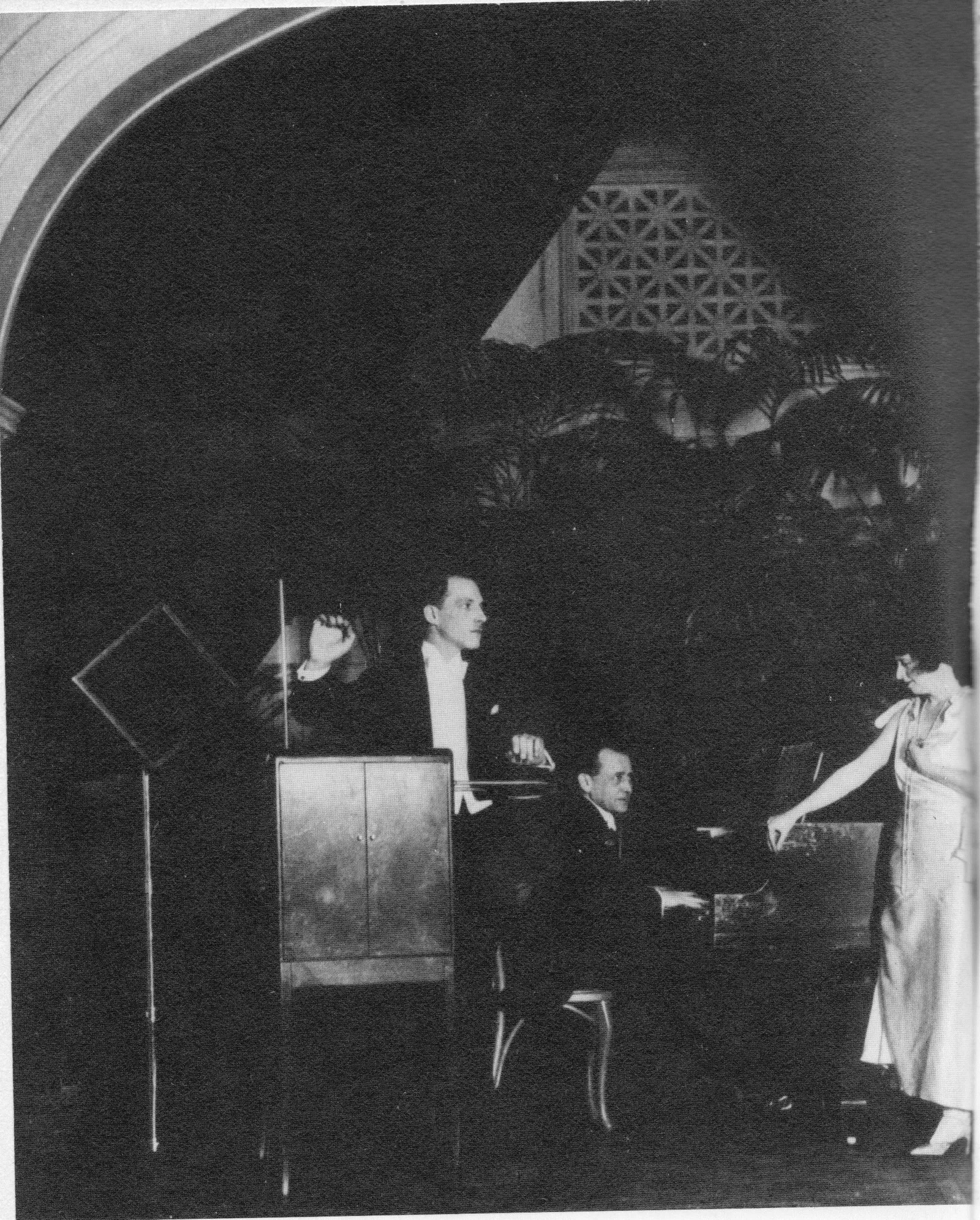
The theremin is played with two hands, and both hang in the air. The right hand moves toward the vertical antenna and away from it, changing the pitch; the left floats over a horizontal loop and controls the volume. The hand works as one plate of a capacitor, the antenna serves as the other plate, and the distance between them sets the frequency of one of the two oscillators inside the box, while the difference between the oscillators sounds from the speaker. An instrument like this has no keys, no frets, nothing at all to brace against, so you cannot hit a note on the theremin; you have to catch it anew every second, the way a tightrope walker catches his balance, and a tremor of the finger that no one would hear on a piano turns straight into a wrong note here.
After the Kremlin, Theremin was sent to show the instrument to the world. In 1927 he toured Europe, on the thirtieth of December of that year he arrived in New York, and in 1928 he performed with the New York Philharmonic, received an American patent and sold the manufacturing rights to RCA. The RCA Theremin went on sale in 1929, almost at the same moment as the stock market crash, cost a hundred and seventy-five dollars without tubes and the recommended loudspeaker, and a full set came to about two hundred and thirty. Around five hundred were made. For a country where millions of people were discovering in those months that their savings had turned into thin air, an instrument played by grabbing at thin air came at the wrong time.
The theremin did, however, find its virtuoso. Clara Rockmore, a violinist who had to give up the violin because of an illness of her hands, mastered the instrument so well that she performed the classical repertoire on it in concert halls all over America, and listeners who came to see an electric trick left feeling they had heard music. The wider public, though, remembered the theremin for something else. Hollywood quickly understood that this trembling, disembodied voice was perfect for everything that could not be shown on screen directly, and the theremin was heard in Hitchcock’s psychological thriller “Spellbound” (1945), and later in the science-fiction film “The Day the Earth Stood Still” (1951). An instrument conceived as an electric cello had become, by the middle of the century, the official voice of madness and flying saucers.
In 1949 a fourteen-year-old New York schoolboy named Robert Moog built a theremin from a diagram in a magazine, and in 1954, at nineteen, he started a small company in his parents’ house that sold ready-made theremins and do-it-yourself kits by mail. Ten years later he would build his first synthesizer. Theremin himself suddenly returned to the Soviet Union in 1938.
In France, meanwhile, an experiment of its own was under way, and it began with the same whistle in the headphones. Maurice Martenot served as a radio operator in the First World War and remembered how the tones of military tube oscillators, accidentally overlapping, added up to clean, almost singing sounds. Martenot was a cellist, and he wanted to get from electricity the expressiveness he achieved with a bow. In 1928 he showed the public his instrument, the ondes Martenot, the “Martenot waves”.
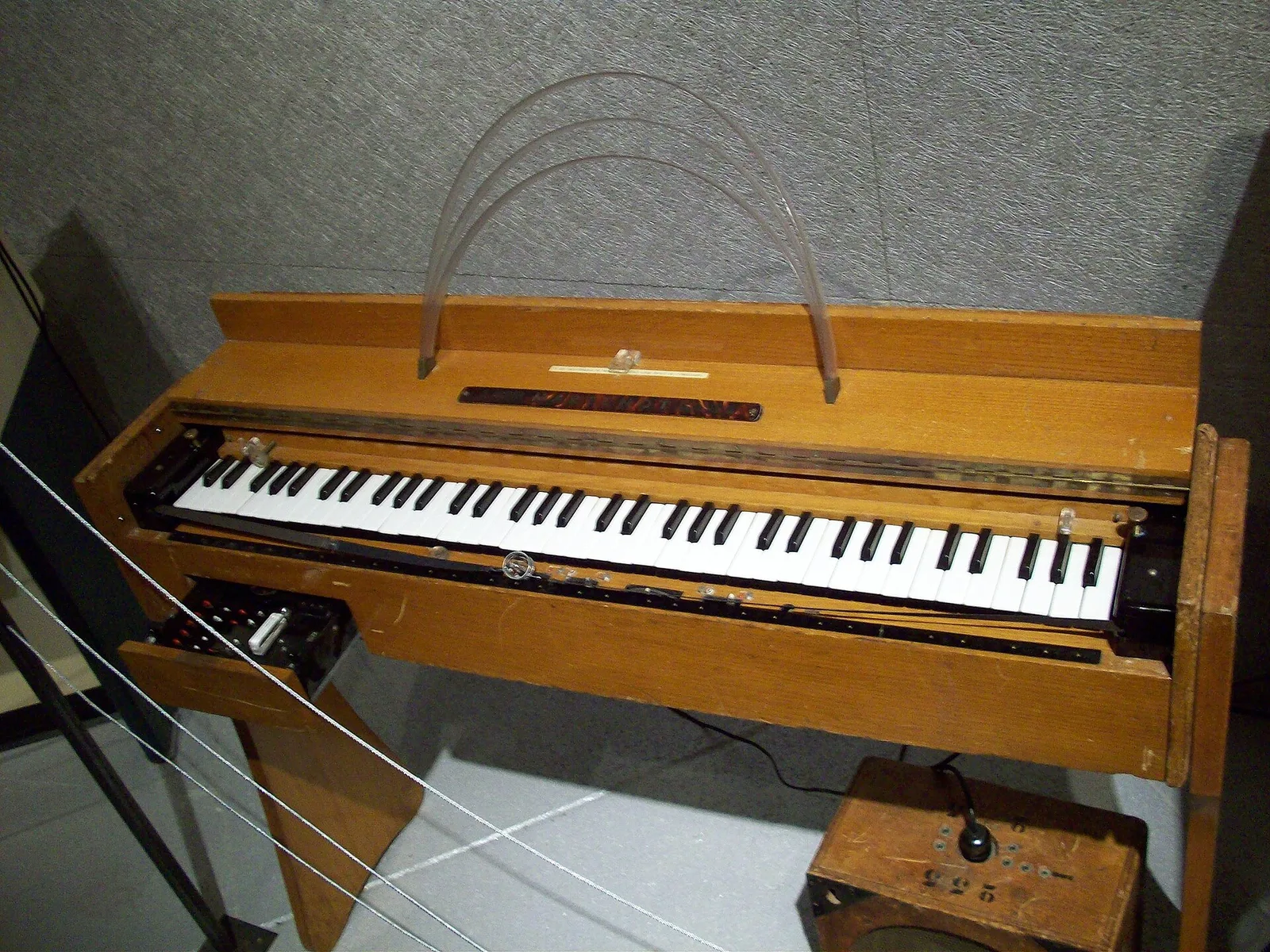
Martenot saw the theremin’s weakness at once: the performer’s hand has nothing to lean on. So on the early models he stretched a wire in front of a painted keyboard, with a ring that the musician put on a finger and slid along the keys, so the note was set by the position of the hand, but the hand now had a map. On later models Martenot installed a real keyboard, and each key could be rocked sideways to produce vibrato, while the left hand controlled volume from a pull-out drawer with a sensitive button. Martenot even invented his own loudspeakers: in one a gong sounded instead of a cone, in another there were strings tuned to all twelve semitones, which picked up the sound and resonated with it.
Composers loved the instrument. Arthur Honegger brought it into his oratorio “Jeanne d’Arc au bûcher” (1935), Olivier Messiaen made it one of the main colours of his “Turangalîla-Symphonie” (1949), and half a century later Jonny Greenwood of Radiohead dragged the ondes Martenot onto the album “Kid A” (2000), and a good share of listeners heard the sound for the first time without suspecting they were listening to an instrument invented under the impression of First World War radio interference. Production stopped in 1988, and original instruments have been valued as antiques ever since.
Theremin and Martenot, without knowing it, started the first argument in history about the interface of an electronic instrument. Theremin gave the musician complete freedom and took away his support; Martenot gave back the support in the form of a keyboard and kept the electric voice. Forty years later the same argument would be repeated between two American engineers, one of whom would put a keyboard on his synthesizer while the other refused on principle to do so, and a hundred years later the interface of a musical instrument would become an ordinary phrase in human language.
 archive
By the end of the 1920s music had, for the first time in thirty-five thousand years, a sound source that needed no muscle. Everything else still stayed with the human. Every note was still played live, by hand, in real time; the machine only oscillated and fell silent the second the musician took his hand away from the antenna. By then people had known how to record sound for half a century, since Edison’s phonograph, but a recording remained a cast of one performance, which could be played back but could not be cut up and put together again. To hand the machine the next part of the work, the memory of sound, it took magnetic tape and a person who thought of picking up a pair of scissors.