Interlude. What a MIDI Cable Actually Carries
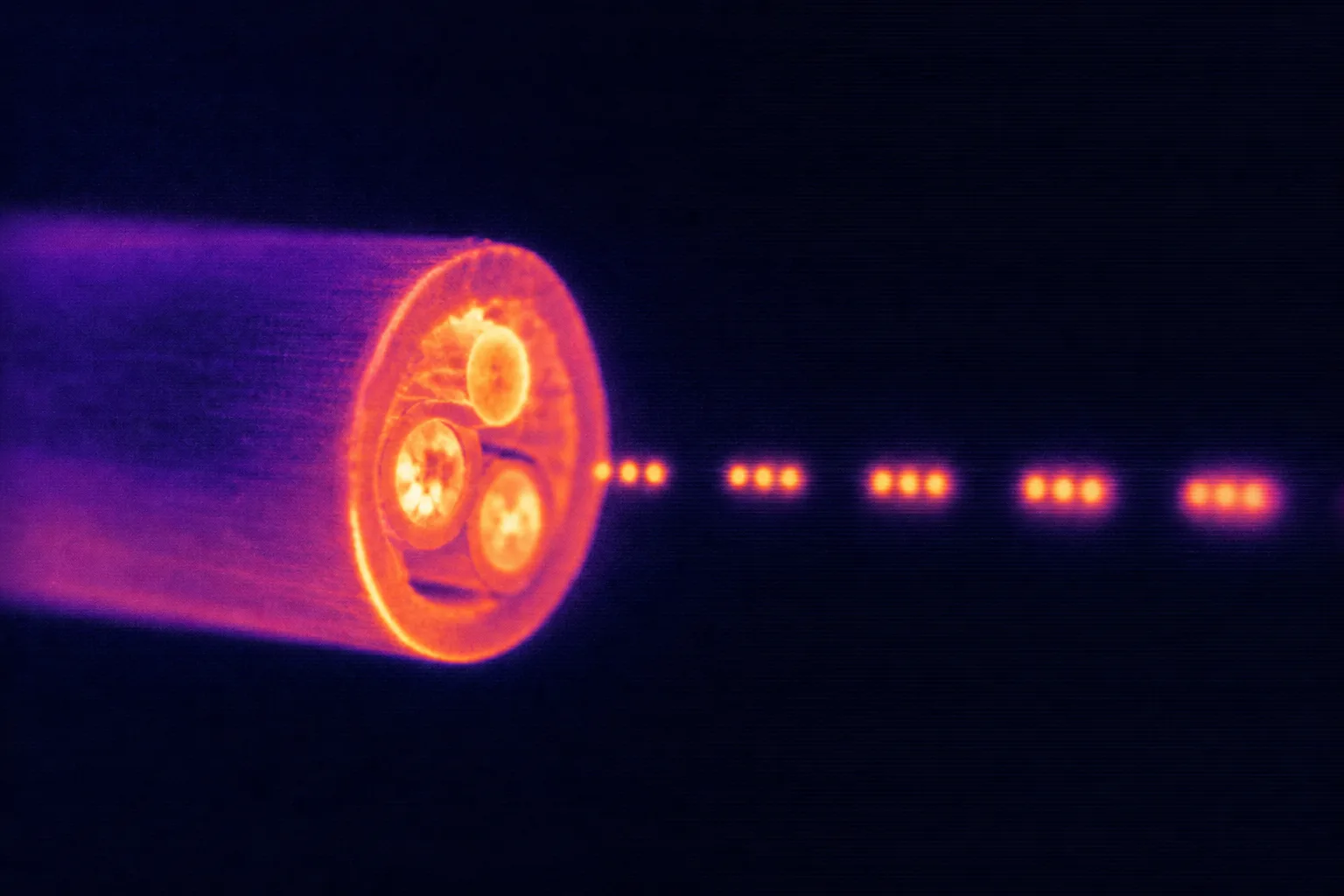 thermal
If you cut a MIDI cable in the middle while a sonata is being played through it and eavesdrop on what runs down it, there will be no sonata there. When a pianist presses middle C on a synthesizer, three numbers go into the cable. The first means “note on, channel one.” The second, sixty, is the key number: the engineers numbered all the keys in a row, and middle C got the number sixty. The third, say, a hundred, is the velocity on a scale from zero to one hundred and twenty-seven. When the pianist releases the key, three more numbers go into the cable. Nothing else. Any performance, from a children’s étude to virtuoso Rachmaninoff, looks on a MIDI cable like a long queue of triplets of numbers with time stamps.
The numbers run down the wire one bit at a time, thirty-one thousand two hundred and fifty bits per second, and with the service bits each number takes ten. One key press, three numbers, occupies almost exactly one millisecond on the wire. For a single note that is an instant. For a chord it isn’t: if the pianist plays a ten-note chord, the cable sends the notes in turn, one after another, and the last note arrives about seven milliseconds after the first, even with a trick that avoids repeating the first number for each following note. Strictly speaking, a chord over MIDI never sounds simultaneously, it always unrolls a little in time, like a very fast arpeggio. By ear a dozen milliseconds is almost unnoticeable, but when several dense parts go down one cable at once, the delays add up, so heavy parts were split across different cables.
This chapter is in the full book
The prologue and the first three chapters are open. The rest of the book, 44 more parts with illustrations, in four languages, opens after one payment. Yours for good.
Sign in first: the book is tied to your INITE account, so it opens on any device.