Music as Navigating a Space of Possibilities
 thermal
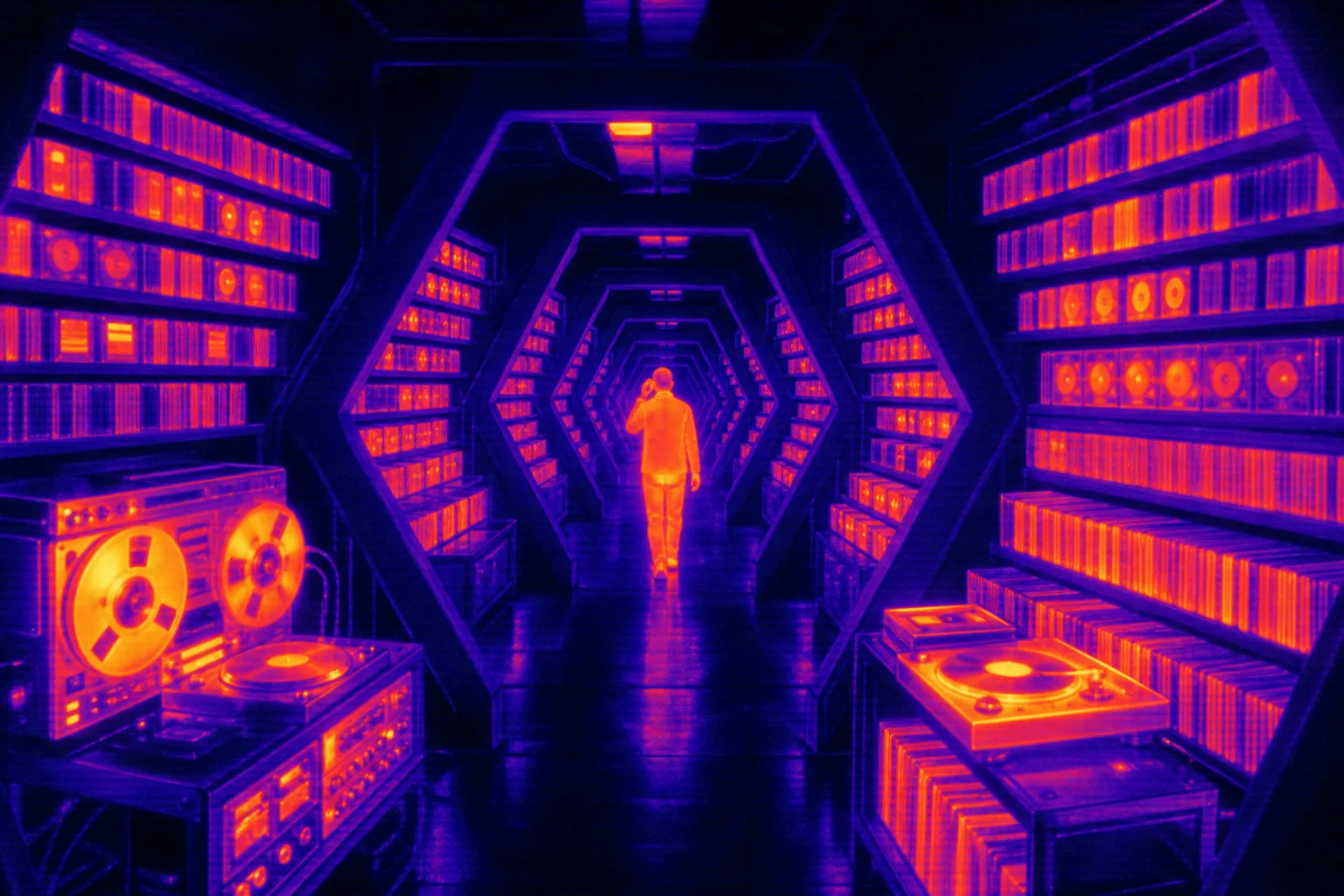
In 1941 Jorge Luis Borges described the Library of Babel, an infinite building of hexagonal rooms whose shelves hold every book that can possibly be printed with twenty-five characters. It contains every book already written and every book not yet written, the exact history of the future and its refutation, but almost all the volumes are filled with nonsense, and the librarians wander the rooms all their lives in the hope of finding even one meaningful page. Borges was writing about infinity, and what came out was an exact description of what a musician now does.
The library was later built, twice in fact. In 2015 the Brooklyn writer and programmer Jonathan Basile launched a website where an algorithm, given a shelf number, produces any page of three thousand two hundred characters that can be put together from the twenty-six letters of the English alphabet, the space, the comma and the period. He explained that his first thought had been that someone had surely done this already. And in February 2020 the American copyright lawyer and musician Damien Riehl, together with the programmer Noah Rubin, generated every melody of eight notes within a single octave over twelve beats, sixty-eight point seven billion of them, at a rate of three hundred thousand melodies a second, and gave up all rights to them. Their goal was legal. Riehl wanted melody plagiarism cases to stop hearing the argument that one composer had subconsciously stolen from another, since all such melodies were now published and belonged to everyone. Numbers, he said, are facts, and copyright barely covers facts. The musical Library of Babel has now existed for six years, and nobody has yet pulled a song out of it, because eight notes are not yet a song, and there is nothing to search sixty-eight billion with except your own ear.
This chapter is in the full book
The prologue and the first three chapters are open. The rest of the book, 44 more parts with illustrations, in four languages, opens after one payment. Yours for good.
Sign in first: the book is tied to your INITE account, so it opens on any device.