Native Instruments and the DJ Without Records
 thermal
For a long time the DJ remained a man with bags. He arrived at the club bent under crates of vinyl, and all the music he could play in a night travelled with him. If at three in the morning the room asked for something that had stayed at home on a shelf, the room did not get it.
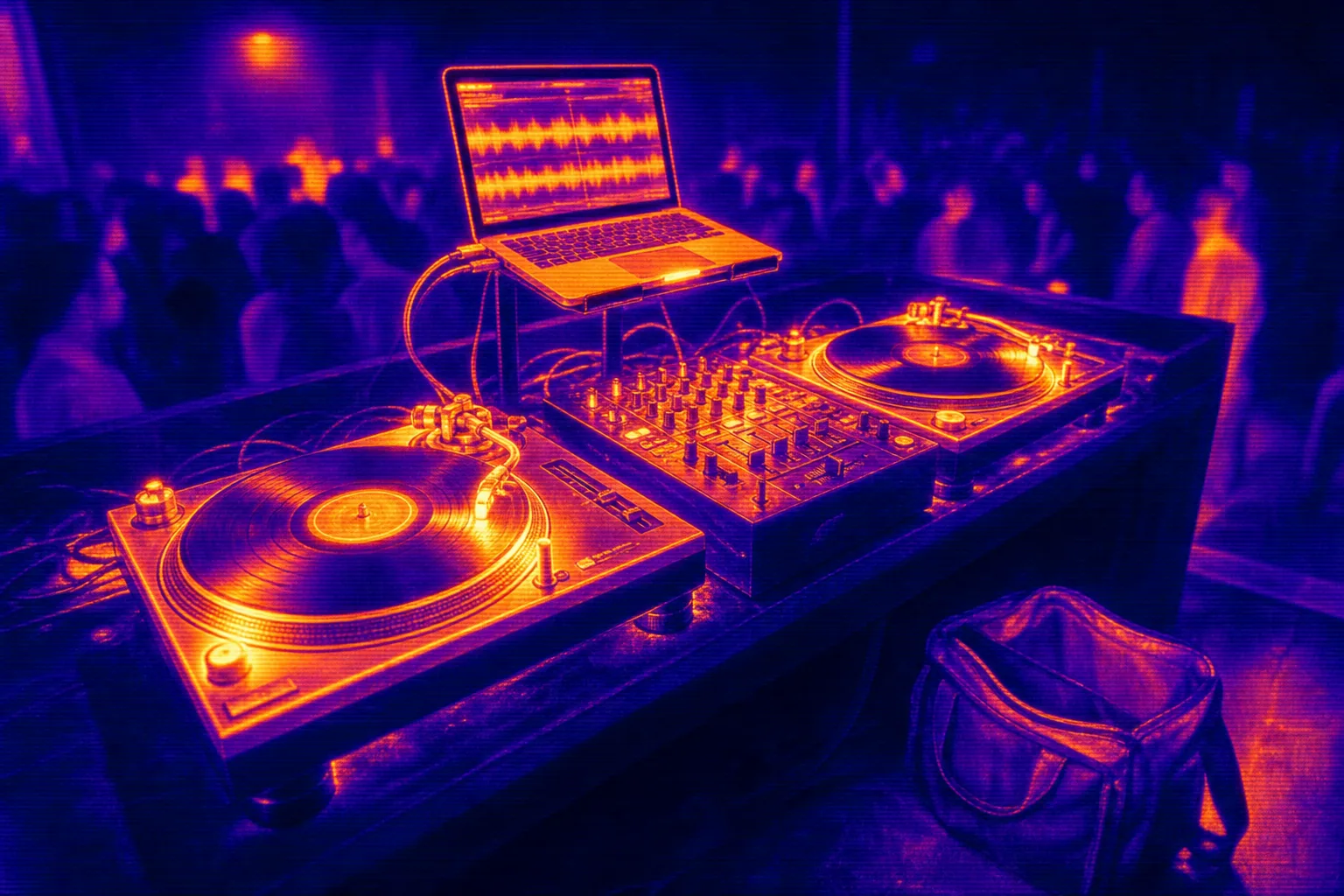
For thirty-odd years this man’s workstation was one and the same pair of turntables. In October 1972 Matsushita released, under the Technics brand, the SL-1200 direct-drive turntable, in which the motor itself turned the platter, with no rubber belt, which on cheap players stretched and started to drift. The engineers put in the speed control for a modest task, correcting inaccuracies in rotation, and hardly thought people would buy the turntable for it. DJs found an instrument in that control. If you speed up slightly the record that is so far playing only in your headphones to match the one playing to the room, the kicks of two different tracks will land beat on beat, and one song will flow into the other without a seam, so that the dance floor does not even notice the music has changed. In 1979 the MK2 model got a long pitch fader and quartz lock, and a pair of Technics with a mixer in the middle became the DJ booth in every club in the world. More than three million were sold, and one unit is on display in London’s Science Museum among the things the modern world is made of.
This chapter is in the full book
The prologue and the first three chapters are open. The rest of the book, 44 more parts with illustrations, in four languages, opens after one payment. Yours for good.
Sign in first: the book is tied to your INITE account, so it opens on any device.